




NEWS
Oct. 21, 2025
Share
Southeast Asia remains at the center of global apparel manufacturing shifts. Recent macro data and industry reports underscore robust activity in countries such as Vietnam, Bangladesh, and Indonesia — even as tariff pressures and shifting trade policy introduce new sourcing considerations for brands. Vietnam’s strong export growth and ongoing investment into textile and garment capacity underscore the region’s importance.
Two structural trends are shaping opportunity for manufacturers and OEM/ODM partners. First, digitalization and smart manufacturing — including automation, AI-supported demand forecasting, and improved traceability — are becoming core differentiators. Producers adopting smart lines reduce lead times, improve quality consistency, and lower labor dependency — attributes valued by international wholesalers and brand partners seeking reliable replenishment and smaller MOQ flexibility.
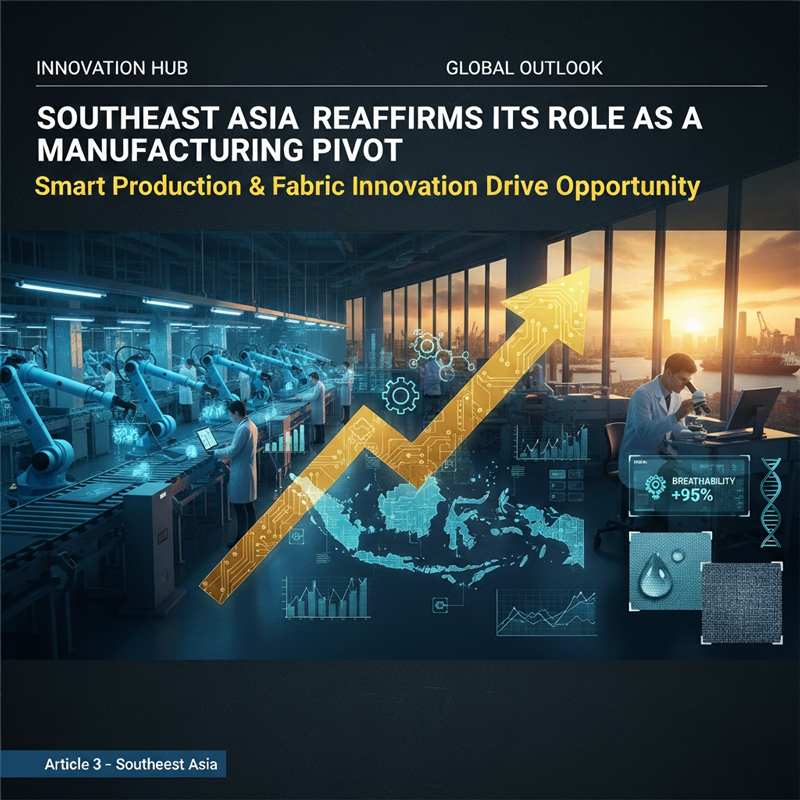
Second, material innovation is accelerating. Sustainable and high-performance textiles (bio-based fibers, recycled blends, and new finishing techniques) are moving from niche to mainstream. Suppliers who can integrate these materials and demonstrate testing—such as breathability, moisture-wicking, or durability performance—are more likely to win OEM/ODM contracts from brands that face rising consumer demand for both function and sustainability.
These dynamics matter for wholesalers and distributors that buy from the region. In practice, buyers want manufacturers who can: produce samples quickly, iterate designs based on market feedback, and scale without quality drift. Many brands now favor dual-mode partnerships: an ODM baseline for core seasonal ranges and OEM flexibility for exclusive drops or private-label assortments. That approach reduces time-to-market while preserving the ability to offer localized or exclusive products.
However, the region also faces headwinds. Proposed or implemented tariffs in key export markets have introduced uncertainty for suppliers, and smaller factories without investment in efficiency risk losing orders to more automated peers. That said, producers that combine modern equipment, optimized processes, and transparent QA systems — and that can document sustainability credentials — will likely remain the preferred partners for global wholesalers and fashion brands.
Key sources / recommended reads & media:
Vietnam export & macro data — Reuters / Vietnam Briefing.
Smart manufacturing & supply chain trends — TextileWorld / WhatTheyThink.
Fabric innovation & sustainability — Heuritech / SGS reporting.
Image / video suggestions:
Factory floor images showing automated lines and fabric testing labs (industry reports).
Short video explaining fabric innovations or smart production use cases.
Latest News
Tips for Choosing the Right Men's Shirt Manufacturer
Choosing the right men's shirt manufacturer is one of the most important decisions for fashion brands, wholesalers, retailers, and private label businesses.
Jul. 28, 2026
Print Shirt Size Guide: US, EU and Asian Size Comparison
Finding the right print shirt size is just as important as choosing the right design. Size standards vary across countries and brands, which can make online purchasing challenging—especially for international buyers. A shirt labeled "L" in Asia may fit differently from a US or EU "L.
Jul. 17, 2026
How To Start Private Label Clothing Brand?
A private label clothing brand is a fashion business model where a company creates its own clothing designs and sells products under its own brand name, while production is handled by a professional manufacturer.
Jul. 10, 2026
Let's Take This Forward!
Feel free to reach out for any queries. We would be happy to help!


