




NEWS
Oct. 07, 2025
Share
The Middle East fashion market is demonstrating resilient demand for imported apparel, with import volumes and consumer appetite for trend-driven and bespoke pieces continuing to rise. Recent trade data shows apparel imports into the region grew year-on-year, underlining persistent retail demand even amid geopolitical and macroeconomic headwinds.
Two converging trends are particularly notable. First, streetwear and youth-driven fashion are flourishing in urban centres across Saudi Arabia and the UAE, propelled by local youth culture, social media, and a growing calendar of fashion events such as regional fashion weeks that spotlight domestic talent. This cultural momentum has broadened the market for bold, design-forward collections that can be localized through small-batch runs and co-branded collaborations.
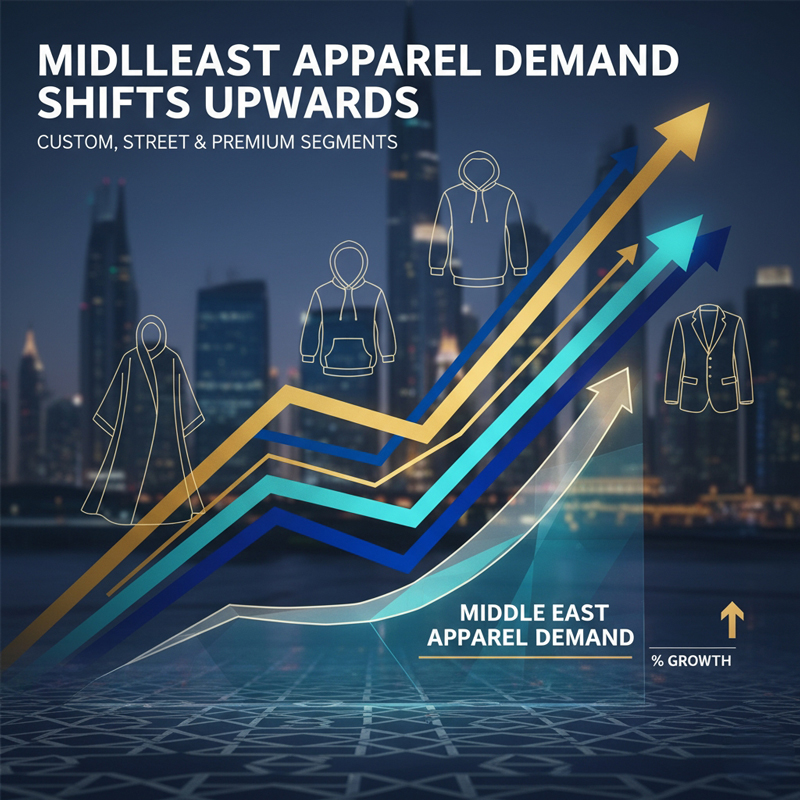
Second, demand for customized and branded apparel is expanding. Market analyses indicate the custom apparel segment in the Middle East is expected to grow in the coming years as consumers — especially millennials and Gen Z — prioritize unique, culturally resonant pieces. For suppliers, this means increased opportunity for ODM collections tailored for local tastes, and OEM partnerships where regional wholesalers or brands require private-label ranges with strict sizing and packaging standards.
From a manufacturing and sourcing perspective, the region’s import patterns highlight room for value-added suppliers who can combine design sensitivity with supply reliability. Wholesalers and distributors are seeking partners who deliver: accurate regional fit adjustments, rapid sampling, and consistent quality control — particularly for small-to-medium batch orders that test market appetite before scaling. Suppliers that pair an ODM base collection with flexible OEM options (custom logos, labels, and localized packaging) are positioned to capture recurring orders and expand into additional retail channels across the Gulf and Levant.
For factories and manufacturers, the practical takeaway is clear: resilience in servicing the Middle East requires both product relevance (styles that match local trends) and operational responsiveness (fast sample turnaround, adaptable MOQ, and reliable logistics). Investment in region-sensitive pattern adjustments, quality control workflows, and branded packaging often rewards suppliers with lower return rates and deeper distribution relationships. In short, the Middle East market favors partners who combine trend awareness with executional reliability — a sweet spot for well-equipped OEM/ODM manufacturers that can bridge design and delivery.
Key sources / recommended reads & media:
Imports & trade trends — Fibre2Fashion.
Streetwear & cultural drivers — JingDaily.
Custom apparel market overview — Credence / Cognitive Market Research.
Regional fashion role & events — Istituto Marangoni industry overview.
Latest News
Tips for Choosing the Right Men's Shirt Manufacturer
Choosing the right men's shirt manufacturer is one of the most important decisions for fashion brands, wholesalers, retailers, and private label businesses.
Jul. 28, 2026
Print Shirt Size Guide: US, EU and Asian Size Comparison
Finding the right print shirt size is just as important as choosing the right design. Size standards vary across countries and brands, which can make online purchasing challenging—especially for international buyers. A shirt labeled "L" in Asia may fit differently from a US or EU "L.
Jul. 17, 2026
How To Start Private Label Clothing Brand?
A private label clothing brand is a fashion business model where a company creates its own clothing designs and sells products under its own brand name, while production is handled by a professional manufacturer.
Jul. 10, 2026
Let's Take This Forward!
Feel free to reach out for any queries. We would be happy to help!


